
If you've spent any time around artificial intelligence (AI) news lately, you've probably noticed two terms getting thrown around a lot: generative AI and agentic AI. People sometimes use them interchangeably, which causes a fair amount of confusion, especially for IT teams trying to figure out what to actually invest in.
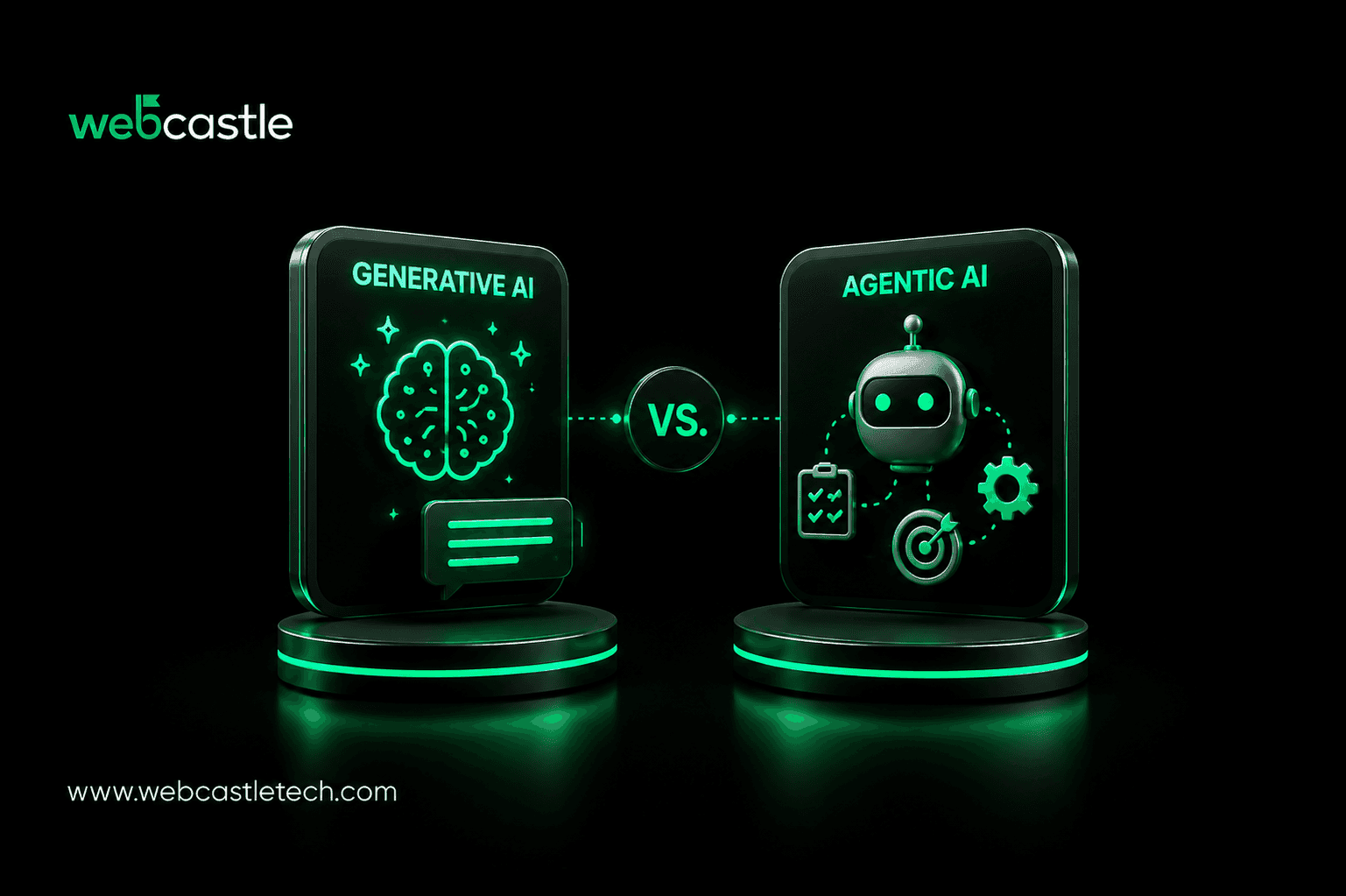
Here's the short version: generative AI creates things. Agentic AI does things. That one-line distinction matters more than it sounds, because it changes how each type of AI fits into your workflows, what kind of oversight it needs, and what problems it can realistically solve.
This article breaks down both technologies in plain terms, walks through where they actually differ, and helps you figure out which one (or both) makes sense for your team.
What Is Generative AI?
Generative AI, is a type of artificial intelligence (AI), refers to systems that produce new content based on a prompt. That content might be text, images, code, audio, or video. Tools like ChatGPT, Midjourney, and GitHub Copilot all fall under this category.
These systems are typically built on large language models (LLMs), which are trained on massive amounts of text and other data. When you give the model a prompt, it predicts what should come next based on patterns it learned during training. It's not "thinking" in the human sense. It's generating output based on probability.
The key thing to remember is that generative AI is reactive. It waits for input and responds to that input. It doesn't decide on its own to go do something next.
What Is Agentic AI?
Agentic AI takes things a step further. Instead of just responding to a single prompt, an agentic system is given a goal, and it figures out the steps needed to achieve that goal on its own.
Agentic AI often uses an LLM as its "reasoning engine," but it pairs that with the ability to plan, make decisions, and take actions across multiple steps without a person prompting each one individually. It can also call external tools, APIs, or software systems to carry out those actions.
A practical example: an agentic AI system tasked with managing customer support tickets might read incoming tickets, categorize them, pull relevant account data from a CRM, draft a response, and escalate anything unusual to a human, all without someone manually triggering each step.
Key Differences Between Generative and Agentic AI
Content Creation vs. Task Completion
Generative AI is built to produce output. It's the right tool when you need a first draft, a design concept, a piece of code, or a summary of a document.
Agentic AI is built to complete a process. It's designed for situations where multiple steps need to happen in sequence, and where the system needs to figure out the right order and adjust along the way.
If your goal is "write this," generative AI fits. If your goal is "handle this from start to finish," agentic AI is the better match.
Autonomy and Decision-Making
This is probably the clearest distinguishing factor. Generative AI has no autonomy. It produces one output per prompt and stops. Every action requires a person to initiate it.
Agentic AI has a degree of autonomy built in. Once given a goal, it can decide what steps to take, in what order, and adjust its approach if something doesn't work as expected. This doesn't mean it operates without any guardrails. Most well-designed agentic systems include checkpoints where a human reviews or approves key decisions, especially for anything with real-world consequences like sending emails or making purchases.
Interaction Model: Prompt-Response vs. Goal-Driven
Generative AI follows a simple loop: you provide a prompt, it returns a response, and the interaction ends unless you prompt it again. This is sometimes called a single-turn or few-turn interaction model.
Agentic AI operates on a goal-driven model. You define an outcome, and the system runs its own internal loop of planning, acting, checking results, and adjusting until the goal is met or it hits a limit it can't resolve on its own.
Use of Tools and External Systems
Generative AI can be connected to external tools, but typically only when a person requests that connection for a specific task. Basic generative AI usage doesn't require any tool access at all.
Agentic AI depends on tool use as a core part of how it functions. To complete multi-step tasks, it usually needs to interact with databases, APIs, scheduling systems, or business software. Without that access, it can't actually complete the tasks it's given, since it can only plan them.
Which AI Is Right for Your Business?
The honest answer is that most businesses will end up using both, just for different jobs.
Generative AI makes sense when:
You need help drafting content, code, or design assets
A human will review and edit the output before it's used
The task is a single, self-contained request
Agentic AI makes sense when:
A process involves multiple steps that currently require manual coordination
The task is repetitive and rule-based enough to define clearly
You have systems in place (APIs, integrations) that the AI can actually connect to
For IT teams specifically, a practical starting point is identifying workflows that are already documented step by step, like ticket triage, data entry between systems, or routine report generation. These are easier to hand to an agentic system because the steps are already known. Creative or judgment-heavy work, like writing marketing copy or reviewing legal documents, still benefits more from generative AI paired with human review.
The choice between generative AI and agentic AI should ideally be made during the planning stage. If you're rebuilding a website, app, or internal system around AI, it changes how the whole thing is built. That's a decision worth talking through with an experienced development team. Webcastle Media, one of the best web development company in Kerala that understands AI integration can help you plan this from day one, not as an add-on later.
Once your system is up and running, the next challenge is getting people to actually find it. That's where SEO comes in. If you need help with that side too, We are also an experienced SEO Agency in Kerala can guide you through it.
Future Trends in AI
Agentic AI is still relatively early compared to generative AI, which has had a few more years of mainstream adoption and tooling built around it. That said, a few trends are becoming clear.
More vendors are building agent frameworks that let generative AI models plan and execute multi-step tasks, effectively giving existing LLMs agentic capabilities through added tooling rather than a separate technology. Multi-agent systems, where several AI agents coordinate with each other on different parts of a larger task, are also becoming more common in enterprise software.
At the same time, governance and oversight tools are getting more attention, since giving AI systems more autonomy raises legitimate questions about accountability, error handling, and security. Expect more emphasis on audit trails, permission controls, and human-in-the-loop checkpoints as agentic systems get deployed in higher-stakes environments.
Conclusion
Generative AI and agentic AI aren't competing technologies. They're two different tools built for two different jobs. Generative AI is about producing content on request. Agentic AI is about completing a goal through a series of decisions and actions, often with minimal human intervention along the way.
For IT professionals evaluating where to invest time and budget, the real question isn't which one is better. It's which one matches the problem you're trying to solve. Content and drafting tasks still belong to generative AI. Multi-step, repetitive processes are where agentic AI starts to earn its place.
FAQ
Does agentic AI require more computing resources than generative AI?
Generally, yes. Because agentic AI runs multiple steps, calls tools, and may re-evaluate its plan several times, it typically uses more compute and takes longer per task than a single generative AI response.
Which one should a small IT team start with?
Generative AI is usually the easier starting point since it requires less setup and lower risk. Once your team is comfortable with it and has clearly documented workflows, agentic AI becomes a more realistic next step.
Do generative AI and agentic AI use the same underlying models?
Often, yes. Many agentic AI systems are built on top of the same large language models used for generative AI tasks. The difference is in the surrounding architecture, not necessarily the core model.
Will agentic AI replace generative AI tools?
No. They solve different problems. Even as agentic AI adoption grows, generative AI will remain useful for tasks that need direct human review of a single output, like drafting content or brainstorming ideas.