Every day, your customers talk about your brand. They leave reviews, post on social media, send emails, and fill out feedback forms. Hidden inside all these words is something valuable: how people actually feel about your business.
AI sentiment analysis helps you find that feeling. It reads text and tells you if the tone is positive, negative, or neutral. Instead of reading thousands of comments by hand, you get instant insights that guide better decisions.
In this guide, we will explain what AI sentiment analysis is, how it works, and why it matters for businesses of every size.
What Is AI Sentiment Analysis and How Does It Work?
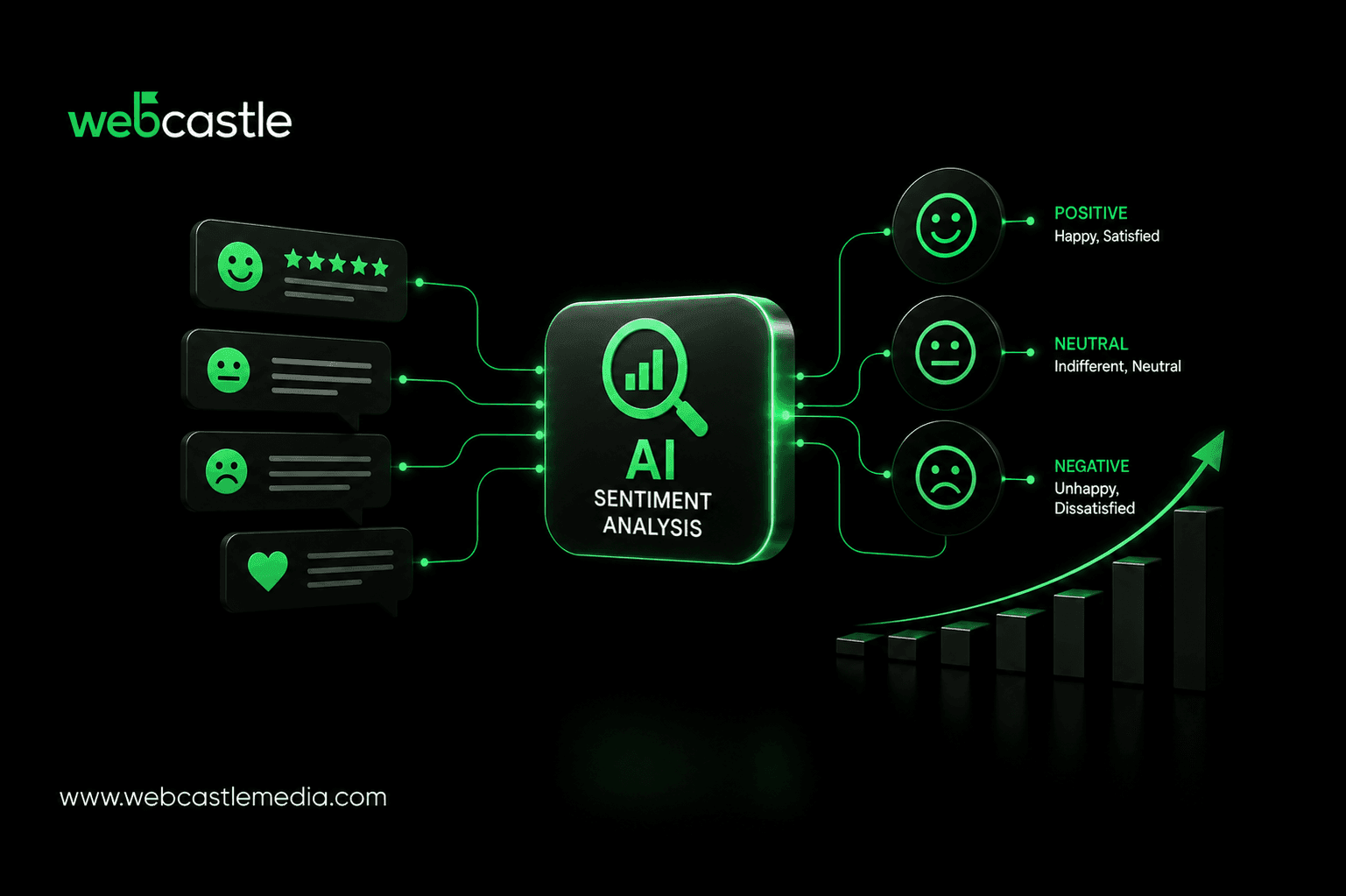
AI sentiment analysis is a technology that uses artificial intelligence and natural language processing (NLP) to detect emotions in written text. It looks at words, phrases, and sentence structure to decide whether the message is positive, negative, or neutral.
Here is a simple example. If a customer writes, "This app is so easy to use, I love it," the system marks it as positive. If someone writes, "The app keeps crashing and support never replies," it gets marked as negative.
Behind the scenes, sentiment analysis tools generally rely on one of three approaches: rule-based, machine learning, or a hybrid of the two. Rule-based systems scan text for words in pre-built positive and negative word lists. Machine learning models instead learn patterns from huge amounts of training data, picking up on which words and phrases usually appear in happy reviews versus angry complaints. Hybrid systems combine both for a balance of speed and accuracy.
Even with these methods, sarcasm, mixed feelings, and missing context remain some of the hardest parts of understanding human emotion in text, a point we'll come back to later.
Most tools also break sentiment into levels of detail:
Binary sentiment: positive or negative only
Ternary sentiment: positive, negative, or neutral
Fine-grained sentiment: very positive, positive, neutral, negative, very negative
Emotion detection: happiness, anger, frustration, sadness, and more
This layered approach gives businesses a clearer picture than a simple "good or bad" label.
Why Do Businesses Use Sentiment Analysis?
Understanding customer emotion is not just nice to have anymore. It shapes real business decisions. Here are the main reasons companies rely on it.
1. Faster customer feedback processing Reading every review or support ticket manually takes time and people. Sentiment analysis scans thousands of messages in seconds, flagging urgent complaints so your team can respond quickly.
2. Better product decisions When customers repeatedly mention the same complaint, such as a confusing checkout process, sentiment analysis helps product teams spot the pattern early and fix it before it affects more users.
3. Brand reputation monitoring Social media moves fast. A single bad experience can turn into a public complaint within minutes. Sentiment tools track brand mentions across platforms and alert teams when negative sentiment starts rising, so issues can be handled before they spread.
4. Improved customer support Support teams can prioritize tickets based on emotional tone. An angry, urgent message gets handled before a calm, general question, improving customer satisfaction.
5. Competitive insights Sentiment analysis is not limited to your own brand. Businesses use it to study reviews and social chatter about competitors, learning what customers like or dislike about other products in the market.
Common Types of Sentiment Analysis Explained
Not all sentiment analysis works the same way. Depending on the business goal, different types are used.
Document-level sentiment analysis This looks at an entire piece of text, like a full review, and gives one overall sentiment score. It is useful for quick summaries but misses details within longer text.
Sentence-level sentiment analysis Here, each sentence is scored separately. This is more accurate for longer reviews where a customer might praise one feature and criticize another in the same message.
Aspect-based sentiment analysis This is one of the most useful types for businesses. It identifies sentiment about specific features or aspects. For example, in the sentence "The camera is great but the battery drains fast," aspect-based analysis separates sentiment for "camera" (positive) and "battery" (negative).
Emotion detection Instead of just positive or negative, this method identifies specific emotions such as joy, anger, or disappointment. It is especially useful in customer support and social media monitoring, where the type of emotion matters as much as the tone.
How Businesses Apply Sentiment Analysis Across Industries
AI sentiment analysis is used in almost every industry today. A few common applications include:
E-commerce: Analyzing product reviews to understand what customers love or dislike about specific items.
Hospitality and travel: Scanning guest reviews on booking platforms to improve service quality.
Banking and finance: Monitoring customer complaints and social sentiment to detect early signs of dissatisfaction.
Healthcare: Reviewing patient feedback to improve care experience.
Marketing: Measuring audience reaction to ad campaigns and social media posts in real time.
Businesses also combine sentiment analysis with other tools, like chatbots and CRM systems, to automatically tag customer interactions and route them to the right team.
Tools and Technologies Used in AI Sentiment Analysis
Several tools make sentiment analysis accessible, even for teams without a data science background. Popular platforms include general-purpose NLP libraries as well as ready-made SaaS tools built specifically for sentiment tracking. Many of these solutions plug directly into social media channels, review platforms, and customer support systems.
For businesses that want more control, custom sentiment analysis models can be built using large language models. These custom setups allow companies to train the AI on industry-specific language, such as medical terms or technical jargon, which general tools might misunderstand.
For SEO professionals, sentiment tracking is not limited to reviews and social posts anymore. Semrush's AI Visibility Toolkit offers reporting built specifically to show how AI platforms talk about a brand. Its Brand Performance report shows how a brand is currently being positioned by AI tools compared to competitors, which is useful as more customers start forming opinions based on AI-generated answers rather than traditional search results alone.
Getting Started with Sentiment Analysis for Your Business
If you are new to sentiment analysis, start small. Pick one data source, such as product reviews or support tickets, and run it through a sentiment analysis tool to see the kind of insights you get. From there, you can expand to social media monitoring, competitor analysis, and deeper aspect-based tracking.
The goal is not just to collect data but to act on it. Sentiment analysis works best when insights are shared across teams, from product development to customer support, so the whole business responds to what customers are really feeling.
As a Digital Marketing Agency in Kerala, WebCastle Media helps businesses turn scattered customer feedback into clear, actionable strategy. From setting up the right sentiment tracking approach to building it into a wider SEO and digital marketing plan, WebCastle Media's team works with brands across India to make sure customer sentiment insights actually translate into better products, campaigns, and support experiences.
Final Thoughts
AI sentiment analysis turns scattered customer opinions into clear, usable insights. It helps businesses respond faster, build better products, and protect their reputation in a world where customer voices are louder than ever.
Whether you run an e-commerce store, a service business, or a large enterprise, understanding how your customers feel is just as important as knowing what they buy. Sentiment analysis gives you that missing piece, one review, comment, and message at a time.