People used to download a separate app for almost every task. One for payments, another for food delivery, another for travel, and another for shopping. Each app served a purpose, but switching between them could mean managing different accounts, payment methods, and user profiles.
That is the problem super apps are designed to address.
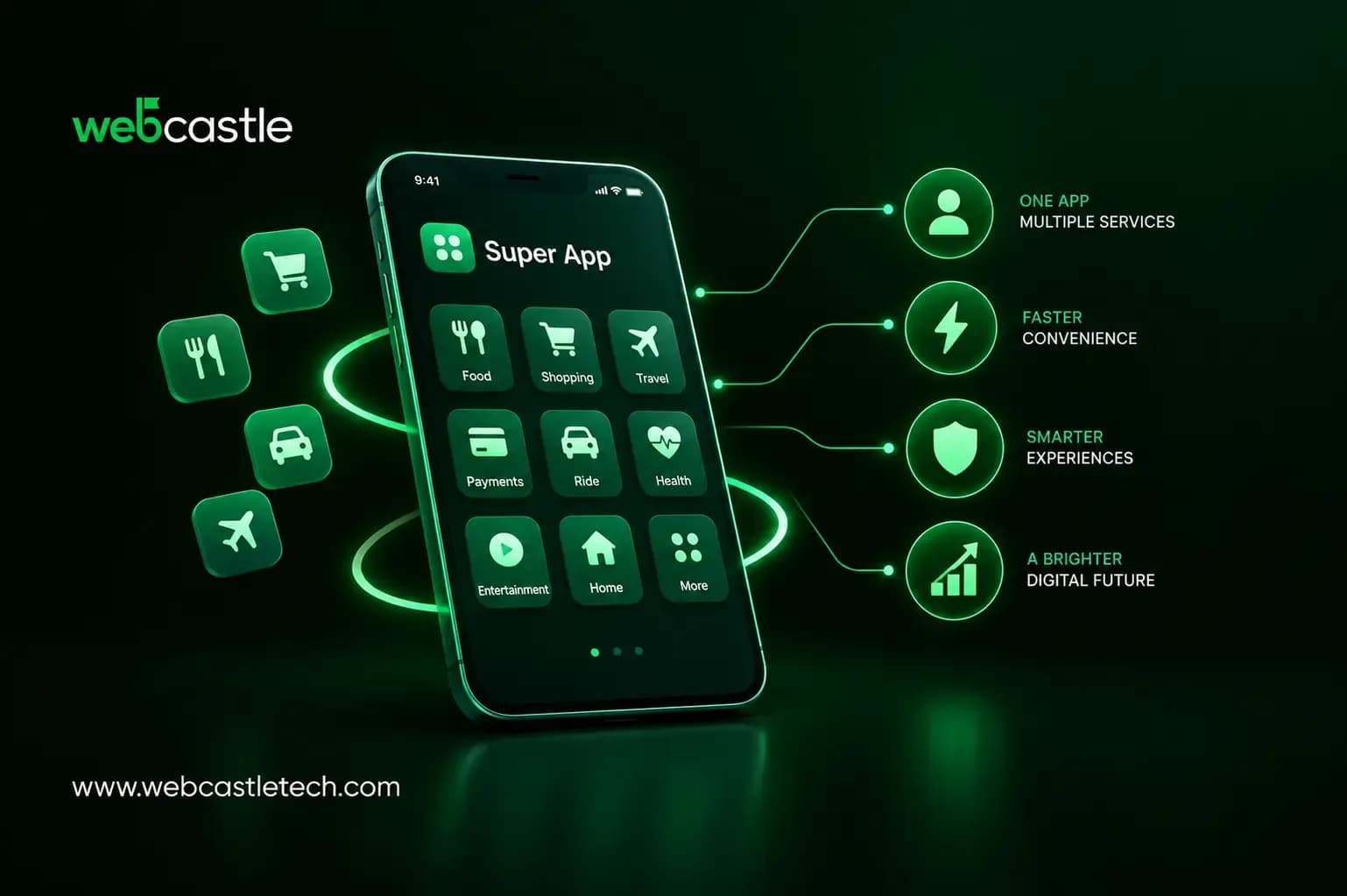
A super app brings multiple services together in one platform. The idea goes beyond adding more features to an existing application. It is about connecting services so users can move between related tasks with less friction.
If your business is considering a super app, check whether,
- Which user problems currently require multiple apps?
- Which services naturally belong together?
- Can users move between services without repeatedly entering their details?
- Can the services share identity, payments, and other essential functions securely?
- Do users have a reason to return to the platform?
According to GSMA Intelligence, super apps can combine services such as banking, payments, and messaging within a platform built around a core technology stack, with mini-apps layered on top. This modular approach allows businesses to introduce new services without building every feature as a separate, full-scale application.
Why Businesses Are Exploring Super Apps
A standalone app can work extremely well when it solves one specific problem. There is no need to combine services simply for the sake of offering more features.
The opportunity arises when customers regularly use several related services. They may need separate accounts, repeat the same steps, switch between interfaces, or complete separate payment processes.
A super app can reduce some of this friction by connecting services through a shared account and interface. For example, a user might book a ride, order food, and pay for both within the same platform.
For businesses, this model can also create opportunities to introduce relevant services to existing users. However, these benefits depend on how well the services fit together and whether customers actually want them.
The Technology Behind a Super App
The interface is only one part of a super app. The underlying architecture must allow different services to work together without making the entire application difficult to maintain.
Several technologies can support this structure:
- APIs: Connect services and allow them to exchange information.
- Modular architecture: Separates application functions so teams can develop and update individual components more easily.
- Cloud infrastructure: Supports backend services, data processing, and changing workloads.
- Identity and access management: Handles user authentication and controls access to accounts and services.
- Payment integration: Allows supported services to use connected payment methods securely.
- Mini-apps: Let users access smaller applications or services within the main platform, where the architecture supports them.
Not every super app needs every component, and mini-apps are not essential to every implementation. The right architecture depends on the services involved, expected usage, integration requirements, and security needs.
Planning these elements early can help businesses introduce new services without having to redesign the entire platform each time.
How AI Can Make Super Apps More Useful
AI can do more than power chatbots in mobile applications. When there is a clear use case, AI can help users find services, receive relevant recommendations, and complete certain tasks more efficiently.
Potential applications include:
- Product recommendations based on relevant user preferences and activity
- Fraud detection and alerts for unusual transactions
- Smarter search across products and services
- Automated customer support for common enquiries
- Personalised service recommendations
- Demand forecasting to support business planning
AI and machine learning solutions can support these functions through recommendation systems, predictive analytics, natural language processing (NLP), and computer vision. Businesses should choose these technologies based on the problem they need to solve, rather than adding AI simply because it is available.
Any use of personal data should also account for privacy, consent, security, and applicable regulations.
Challenges Businesses Should Consider
Building a super app involves more than integrating several services. The platform must remain easy to use while supporting different functions, data flows, and security requirements.
Common challenges include:
Complexity: Too many features can make navigation confusing and overwhelm users.
Performance: Poorly designed integrations can slow down the app or affect reliability.
Security and privacy: A connected platform may handle large amounts of personal and financial information, making access controls and data protection essential.
Integration: Different services may use separate systems, data formats, and business rules.
Regulatory requirements: Payment services and other regulated functions may require specific approvals and compliance measures.
User trust: People need to understand how their information is used and feel confident using connected services.
The best approach is to begin with a useful core service, then introduce additional features when they solve a clear customer problem. This allows businesses to test demand and improve the platform before expanding further.
What Businesses Should Consider Before Building a Super App
Building a super app requires more than designing screens and adding features. Businesses need a well-planned architecture that connects different services, supports future growth, and keeps the app easy to use.
Before development begins, businesses should identify their target users, map the journeys they want to improve, and decide which services genuinely belong together. They should also consider integration costs, security requirements, expected growth, and how the platform will be maintained.
As one of the best mobile app development companies in Kerala, WebCastle Media works with Android, iOS, Flutter, and React Native, along with AI and cloud services.
The right technology depends on the app's purpose, the services it needs to connect, and its future requirements.
Building a Super App Around Real User Needs
A super app needs more than a long list of features. It requires a clear reason for users to move between services, a flexible architecture, and careful planning for security and performance.
Businesses should start by identifying the services their customers frequently use together. From there, they can decide whether to build a single integrated application, introduce modular services, or develop a broader platform with mini-apps.
Start by identifying the problems your customers face and build a solution around their needs. Add more services as your platform grows and users see real value in them.