Most Kerala E-commerce Brands Are Running Ads the Hard Way
Spend enough time talking to online store owners in Kerala and a pattern comes up again and again. They know digital advertising is important. They are putting money into it. Many businesses run ads, but few can clearly show how those campaigns contribute to growth. As online shopping grows across Kerala, strong digital visibility is becoming increasingly important. The real question is whose products customers are finding.
Brands still relying on basic keyword campaigns and fixed bids are competing against businesses that have moved to ecommerce AI advertising strategies. These newer approaches do not just automate tasks. They make better decisions, faster, and keep improving the longer they run. This post covers what that actually looks like and what Kerala brands need to know to get started.
What Has Actually Changed in Digital Advertising
Digital advertising once relied heavily on manual work. Today, machine learning automates much of the optimisation by analysing vast amounts of data in real time. What someone recently searched. Their purchase history. The device in their hand. The time of day. Their location. Whether they browsed a product page for 30 seconds or three minutes. All of it gets factored into a bid decision that happens before the page loads.
For e-commerce brands, this produces some real and measurable changes:
- Ad spend stops going toward people who show no real purchase intent
- Product listings get matched to relevant search queries
- One campaign can reach shoppers across Search, YouTube, Gmail, and Display
- Ad creative adjusts based on what drives clicks and conversions
- Campaigns improve over time without constant manual intervention
A business selling handwoven products from Kannur or Ayurvedic goods from Palakkad can reach the right buyer at the right moment, on the right device, more reliably than was ever possible with manual campaign management. That is the shift.
Performance Max: The Campaign Format Driving This Change
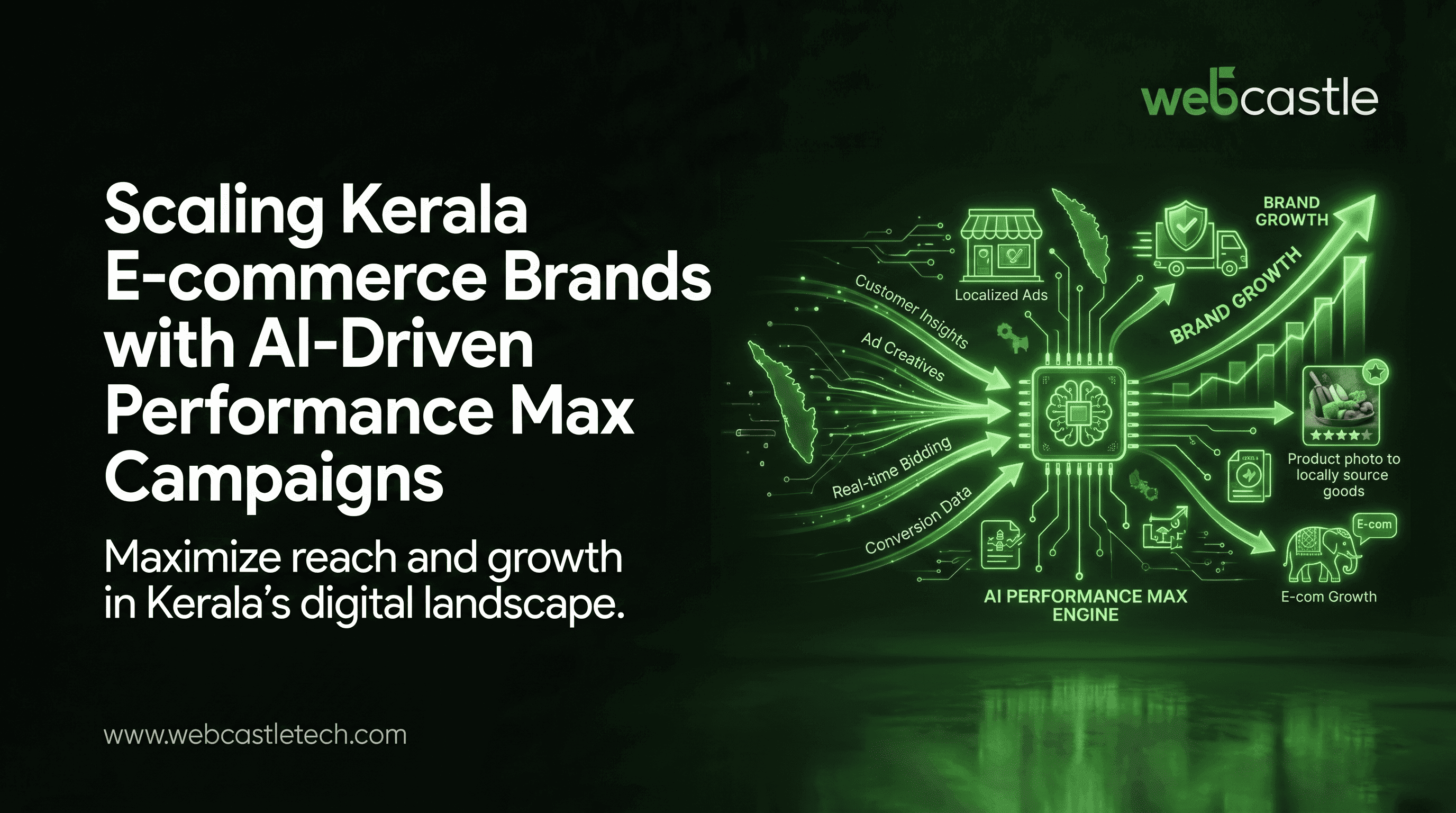
Performance Max (PMax) uses Google’s AI to run ads across all major Google channels, automatically optimising placements, bids, and creatives. Your job is to set the right objective and give it strong inputs.
Here is what each major component of PMax actually does:
Google Shopping AI Optimization
For e-commerce stores, the product feed is the foundation of a PMax campaign. Google matches products to relevant searches and gives more visibility to top performers. This happens without you manually pushing specific products forward, which saves time and tends to produce better distribution across your catalog.
AI Product Feed Management
Feed quality directly affects campaign performance. AI tools can identify missing attributes, category errors, and pricing inconsistencies, helping improve product visibility before launch.
Dynamic Product Retargeting
Dynamic retargeting shows shoppers ads for products they viewed after leaving your website. Not a general brand awareness ad. The specific item they were looking at. For product categories where buyers do not decide immediately, think home appliances, gold jewellery, or premium clothing, this feature brings back a meaningful share of people who were genuinely interested but needed more time.
Smart Bidding
Smart bidding uses Google's AI to automatically adjust bids in real time, helping businesses improve campaign performance and generate more sales.
Automated Ad Asset Generation
You supply the raw material: headlines, descriptions, images, and where possible, short videos. PMax assembles these into thousands of possible ad combinations and tests them in live conditions. The combinations that get results keep running. Those that do not get replaced. This is what automated ad asset generation does in practice. It removes the guesswork from creative testing and handles far more variation than any manual A/B test could manage.
Machine Learning for Inventory Control
Driving paid traffic to a product page where the item is out of stock is one of the most common ways e-commerce brands waste ad spend. Machine learning for inventory-aware advertising connects your stock levels to your campaign so that ads get prioritized for available products and pulled back for anything that cannot be fulfilled. This can improve AI-driven e-commerce conversion rates by focusing ad spend on products that are in stock.
AI Features That Support Long-Term Business Growth
Predictive Customer Lifetime Value
Predictive customer lifetime value (CLV) helps identify customers who are likely to return and spend more over time, allowing businesses to invest more confidently in customer acquisition.
Shopify and AI Ad Integration
Shopify automatically syncs product, pricing, and inventory updates with Google Ads. Order data and customer behaviour also feed back into Google Ads, giving the algorithm better signals for optimization over time. Getting this integration set up cleanly from day one prevents a lot of data gaps that would otherwise limit what PMax can learn.
Multi-Channel Reach
PMax simplifies multi-channel ecommerce marketing by running ads across Google's channels from a single campaign, helping brands reach customers throughout the buying journey.
Audience Signals for PMax
PMax is built to learn on its own over time, but starting without any audience data means the early weeks of a campaign produce weaker results while the algorithm figures out who your customers are. Audience signals for PMax solve this by giving the system a head start. You upload your existing customer data, and the algorithm uses it to find similar users across Google's network from the beginning.
The strongest signals to prepare before launch:
- Past customers sorted by order value, with highest spenders treated as a priority segment
- Website visitors grouped by the product categories they browsed
- People who added products to cart but did not complete a purchase
- Custom audiences built from high-converting search terms
- In-market audience segments relevant to your product categories
Why Kerala Context Changes How These Campaigns Get Structured
Kerala has distinct consumer trends, and events like Onam can significantly influence buying behaviour. It is the largest shopping event of the year across Kerala, and brands that do not plan their budget increases and creative changes around it consistently miss their biggest opportunity. The same applies to Vishu and the academic season, which drives demand spikes in categories that a standard national campaign calendar would never flag. Beyond seasonal planning, the split between urban shopping behavior in Kochi and more price-conscious buying patterns in smaller towns requires campaign segmentation that someone outside the region would not think to build.
Local expertise matters. As a web development company in Kerala and digital advertising agency Kerala, WebCastle Media helps e-commerce brands with website development, platform integrations, product feeds, and performance-driven advertising. Recognized as one of the best web designing companies in Kerala, the team combines well-built storefronts with PMax campaigns designed to deliver results from the start. If PMax is only as good as the feed, tracking, and signals behind it, then having the same team handle both the store and the campaigns removes a significant coordination problem that slows most e-commerce brands down.
Where to Start If You Are Serious About Making This Work
PMax is available to any Google Ads account, regardless of business size or monthly spend. The brands that struggle with it are not the smaller ones. They rushed the setup without getting the basics right.
These five elements should be set up first:
- Product feed quality: Use complete and accurate titles, categories, attributes, and images.
- Conversion tracking: Track purchases, leads, and key website actions accurately.
- Audience data: Upload customer lists, visitor audiences, and cart abandoners before launch.
- Bidding objective: a Target ROAS or conversion value goal tied to actual margin targets, not guesswork
- Patience with the learning phase: PMax needs time to gather data before performance stabilizes, typically two to four weeks minimum
Skip any of these and the campaign will underperform, not because the tool does not work but because it did not have what it needed to work properly. This is the gap that most e-commerce brands in Kerala are sitting in right now. The tools exist. The setup does not.
If sorting out that setup is where you need help, or if you want a clear view of why your current campaigns are not producing what they should, the Webcastle Media team works through exactly these problems with Kerala e-commerce brands on a regular basis.
Get in touch at webcastletech.com. A feed audit, a campaign review, or a full strategy conversation, we can start wherever it is most useful for your business.