
Let’s Talk


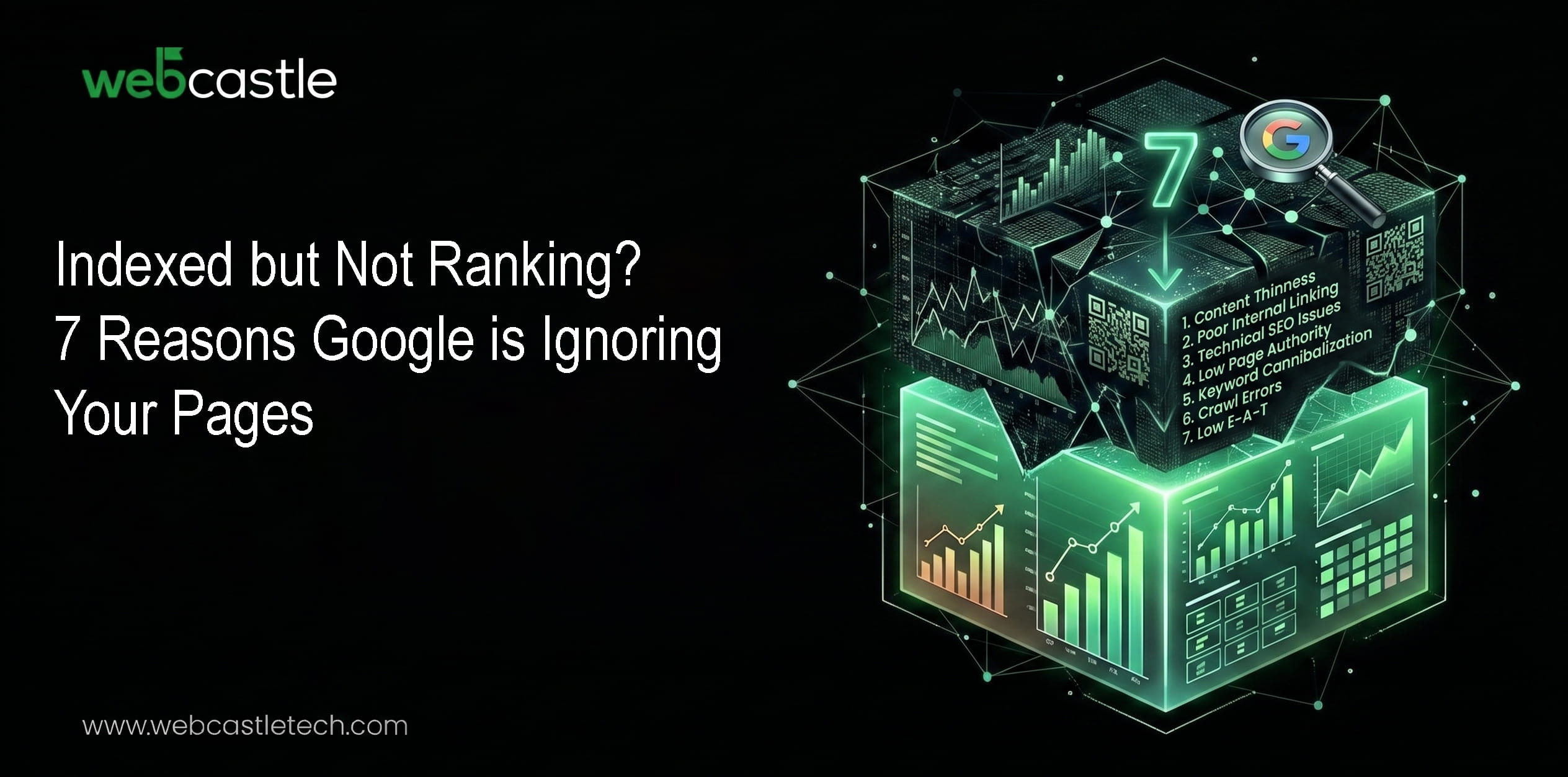
You did everything right. Published the page. Submitted the sitemap. Google crawled it. Website indexed but not ranking.
Yet — page 4. Page 6. Sometimes page 10.
Nobody goes to page 10. Not even you.
Here’s the thing most SEO guides won’t tell you: getting indexed and getting ranked are two completely different games. Indexing just means Google knows your page exists. Ranking means Google trusts it enough to show it to someone with a real question. That trust? It’s earned — and most pages never earn it.
If Google cannot trust your page to rank, then being indexed is meaningless. But missing keywords are not usually the guilty party — thin content (or a lot of other culprits) is, such as weak E-E-A-T signals and cannibalization, bad Core Web Vitals, and misunderstanding search intent. Absolutely — fix these, and your indexed pages actually accomplish things. You keep ignoring them and lazily hanging invisible pages on the web.
The Problem: You are in the Google Library, but on the Wrong Shelf. Consider Google’s index as a huge library. Each page that it indexes gets a shelf. But when someone walks in and asks the librarian a question, the librarian doesn’t hand them every book on the topic — they hand them the most credible, most relevant, most useful one. Your page is in that library. Google just doesn’t think it’s the right book for the question.
If you published a 1,200-word article when they wanted a direct service page — or vice versa — Google spots that mismatch fast. Search intent is the filter Google uses before anything else.
Fix it: Check the format they are in? Match that format first. Optimize tone second.
An 800 to 900-word page that makes the same point with 12 variations is not content — it’s noise. In particular, the Google Helpful Content system (the initial iteration of which launched in August 2022 and has been regularly updated since then) aims at pages that were created for search engines rather than people. You have the perspective, answer, or insight that is original; therefore, your page will rank (if it does not provide something to substantiate a page ranking). It’s that simple. Have your fix-it check like”Let’s put a note for ourselves — does this page being up actually answer something a human needs, or is it just filling space? ” If the reader isn’t certain, it definitely won’t be you.
You wrote three blogs on “web design tips.” It might not be ranking any of them particularly well.
It is called keyword cannibalization — a silent rank killer with zero error messages. How to fix it: So head over to Google Search Console and see which pages are actually ranking for the same queries. Consolidate or differentiate them. Good content always trumps poor content – One solid page every year always beats three weak ones.
Google’s Quality Rater Guidelines center around Experience, Expertise, Authoritativeness, and Trustworthiness of the content. These signals become even more relevant for pages in which topics impact decisions, such as money, health, business, and so on.
No author bio. No credentials. No links from credible sites. No first-hand experience shown in the content. Google reads all of that as a trust gap.
Fix it: Add real author details. Link to credible external sources. Earn backlinks from industry-relevant sites. Write like someone who has actually done the thing — not someone who read about it.
Page speed and user experience are confirmed Google ranking signals. If your page loads slowly, shifts layout after loading (Cumulative Layout Shift), or takes too long to respond to the first tap, Google notices, because users leave.
You can check your actual scores for free at Google PageSpeed Insights.
Fix it: Compress images. Reduce render-blocking scripts. Use a reliable host. These aren’t glamorous fixes, but they move the needle.
A page with zero external links pointing to it is, in Google’s view, a page nobody else found worth referencing. That’s a quiet credibility problem.
But here’s what people miss: bad backlinks — from spammy, unrelated, or low-quality domains — can actively drag a page down. It’s not neutral. It’s negative.
Fix it: Focus on earning links from relevant, credible sources. One good backlink from an industry site is worth more than 50 from random directories.
A brand-new page on a low-authority domain targeting “best SEO company in India” is going up against pages with years of backlinks, authority, and traffic history. That’s not strategy — that’s wishful thinking.
Fix it: Start with longer, more specific keywords where competition is lower, and intent is clearer. Build authority there first. Then go after the bigger terms.
Most people treat indexing as the finish line. It’s not even the starting gun.
Getting ranked requires Google to trust your page — for the right query, with the right signals, on a technically sound site, with credible content. Every gap in that chain is a reason your page stays invisible.
The good news? Every single reason on this list is fixable. None of it requires luck. It requires audit, intent, and consistent execution.
At WebCastle, we don’t just build websites — we build websites that rank, convert, and grow. Our SEO team has helped businesses across India, the UAE, KSA, and beyond move from indexed-but-ignored to page one.
If your pages are sitting in Google’s index doing nothing, it’s time for a real conversation.
Get in touch with WebCastle — and let’s figure out exactly what’s holding your site back.

Call