
Let’s Talk


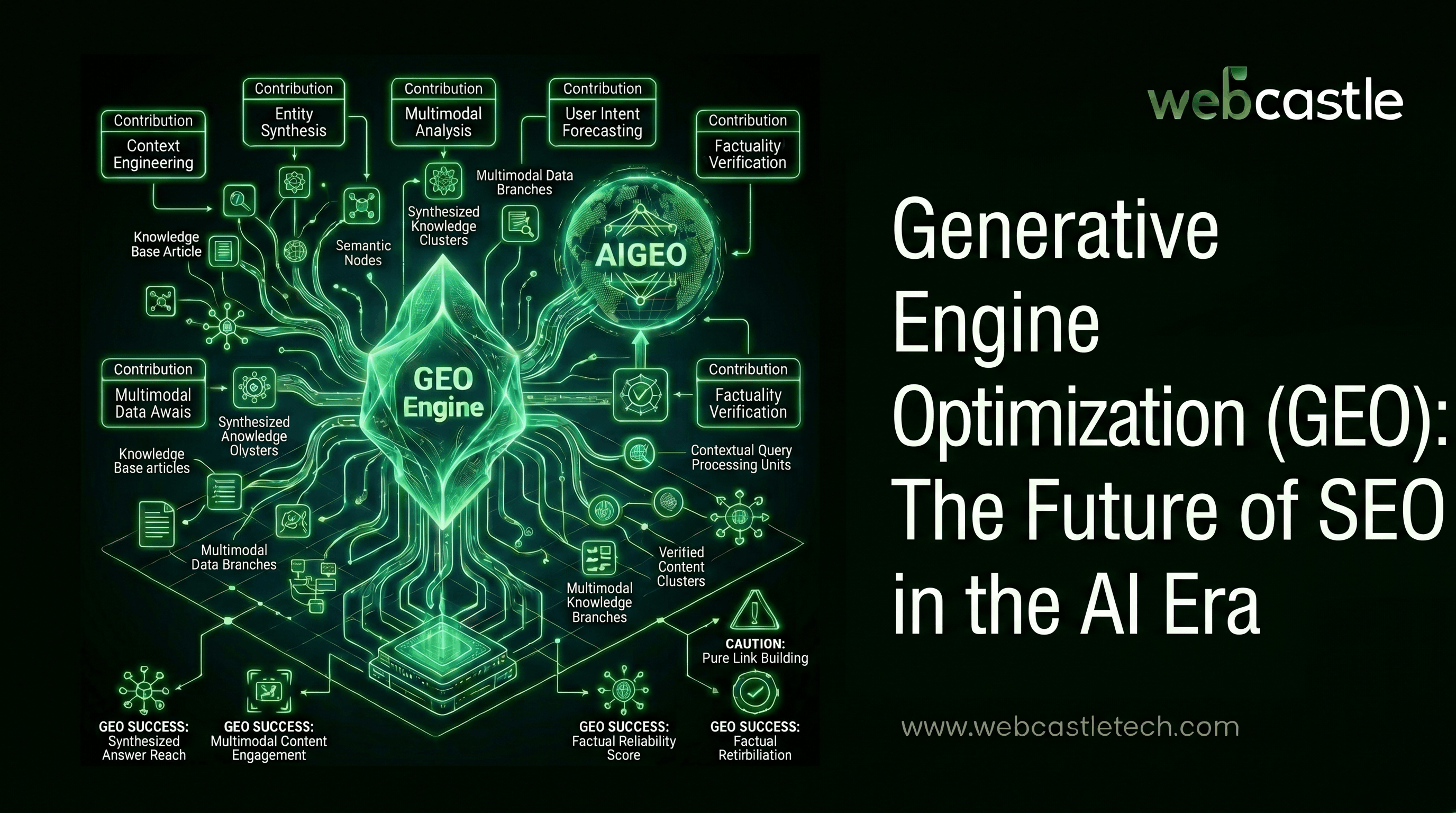
You checked Google Search Console this morning. Impressions are up. Traffic is down. The ranking hasn’t moved. And yet, somehow, fewer people are visiting your site than six months ago.
It’s because the rules of search just changed. Not gradually. Fast.
Now the search results answer the questions directly with AI tools without sending users to your website. A generative engine optimization strategy gets you cited, but the traditional SEO focuses on ranking. This blog breaks down what GEO is, why it matters specifically for businesses, and what to do about it starting today.
For about two decades, the SEO playbook was predictable. Target a keyword. Build backlinks. Optimize your meta tags. Land on page one. Done.
That logic is now only half the picture. Search engines are no longer directing traffic. Generative engines are absorbing it.
Users are now typing full conversational search queries into ChatGPT, Perplexity, and Google’s AI-powered interface – and getting complete answers, with no reason to visit anyone’s website.
GEO isn’t a rebranding exercise. It’s a genuinely different discipline.
Traditional SEO = Optimising for crawlers and keyword matching.
GEO = Optimising for Large Language Models (LLMs) that synthesise, summarise, and cite.
The LLM doesn’t rank your page. It decides whether your content is trustworthy enough to refer to.
Generative engines pull content that directly addresses a query in the first 50–80 words. Lead every page and blog with a crisp, direct answer. Think of it as writing for someone who has already decided to skim. This is the foundation of Answer Engine Optimization (AEO) – and GEO takes it further by ensuring the answer is structured for AI extraction, not just human readers.
Natural Language Processing (NLP) systems don’t reward flowery writing. They reward clarity. Use:
Structuring data for AI bots means your content becomes machine-readable at a deeper level – something most websites still haven’t done.
Entity-based SEO is the backbone of how LLMs understand the world. Google’s Knowledge Graph and LLMs don’t just read your words – they map your brand, your authors, and your topics to known entities. If your business isn’t clearly associated with specific topics through consistent, authoritative content, AI systems have no reason to cite you. Publishing original data, expert perspectives, and content with verifiable sources builds what researchers call an information gain score – essentially, how much new, useful information your content adds versus what already exists online.
Google is no longer the only arena. Optimizing for ChatGPT and Perplexity requires understanding that these tools pull from indexed sources, licensed datasets, and real-time web results. Perplexity, in particular, has become a serious research tool for professionals. Your content needs to be:
The Google Search Generative Experience (SGE) – now called AI Overviews – follows similar logic but with stronger weighting on E-E-A-T signals (Experience, Expertise, Authoritativeness, Trustworthiness). Get those wrong, and your page gets ignored even if it’s ranking on page one.
Being in the AI Overview isn’t just about vanity. It directly converts.
The AI overview’s impact on traffic is no longer theoretical – it’s a metric your business needs to track, alongside impressions and click-through rates.
Most Indian businesses – including many in Kochi, Bangalore, and Mumbai – are still optimising for 2019-era SEO. Keyword stuffing, thin content, and backlink farms. That approach is losing ground fast.
The businesses that will hold visibility through 2026 and beyond are the ones building:
A proper generative engine optimization strategy isn’t optional anymore. It’s the new baseline for digital competitiveness.
GEO doesn’t replace SEO. It extends it into a new environment where the audience isn’t always human on the first touch. Sometimes, it’s an AI reading your content and deciding whether to pass it on.
Your job is to write for both.
The businesses that treat this as a distant future problem will wake up to the same pattern – impressions up, traffic down, conversions flat – and wonder what happened. The ones that act now will be the sources that AI systems cite, trust, and recommend.
At WebCastle, we’ve been helping businesses across Kerala, India, and internationally stay ahead of digital shifts – from the earliest days of mobile SEO to today’s AI-first search environment. Our SEO and digital marketing teams understand that GEO isn’t a buzzword. It’s a structural change in how content gets discovered, evaluated, and surfaced.
If your current SEO strategy isn’t accounting for AI Overviews, LLMs, or conversational search – it’s already behind.
Let’s fix that.

Call